Jack the Ripper: The Suspects History Forgot
In the autumn of 1888, someone murdered at least five women in the Whitechapel district of London’s East End. The killings were savage, methodical, and — despite one of the largest police investigations in Victorian history — never solved. The killer was never identified, never arrested, never tried. He simply stopped, and the silence that followed has been filled, for nearly a century and a half, with speculation.
The name “Jack the Ripper” comes from a letter sent to the Central News Agency on September 27, 1888, almost certainly written by a journalist looking to sell papers rather than by the actual killer. But the name stuck, and it transformed a series of brutal murders into something else entirely: a mystery, a mythology, and an industry.
That industry is the problem. Over the decades, the Ripper case has attracted so many theorists, authors, and amateur detectives that the real investigation has been buried under layers of sensationalism. Royal conspiracies. Masonic plots. Famous painters. The theories that get the most attention are almost always the most absurd, while the suspects that Scotland Yard actually investigated — the men that experienced detectives believed were genuine possibilities — have been largely forgotten.
This is about those forgotten suspects. Not the fantasies. The real ones.
What the Police Actually Knew
Before examining the suspects, it is worth understanding what the Metropolitan Police and City of London Police were working with in 1888. The answer is: not much, but more than most people realize.
There was no forensic science in any modern sense. No fingerprinting — that would not be adopted by Scotland Yard until 1901. No blood typing. No DNA analysis. The police had witness statements, physical evidence observed at the crime scenes, and their own experience with violent crime in the East End. That experience was considerable. The detectives assigned to the Whitechapel murders were not bumbling amateurs. They were seasoned investigators operating within the severe limitations of their era.
The investigation was led by several key figures. Inspector Frederick Abberline, who had spent years policing Whitechapel and knew its streets and residents intimately, coordinated much of the ground-level detective work. Chief Inspector Donald Swanson oversaw the case from Scotland Yard. Sir Robert Anderson, head of the Criminal Investigation Department, and Sir Melville Macnaghten, who joined the CID in 1889, both later wrote about the case and named suspects they considered credible.
It is the private memoranda and later writings of these men — not the newspaper sensationalism of the time — that provide the most reliable window into who the police actually suspected.
Montague John Druitt
In 1894, Sir Melville Macnaghten wrote an internal memorandum listing three men he considered the most likely suspects. The first was Montague John Druitt, a thirty-one-year-old barrister and schoolteacher whose body was pulled from the Thames on December 31, 1888 — roughly seven weeks after the last canonical murder.
Druitt is a fascinating and frustrating suspect. Macnaghten described him as “sexually insane” and stated that his own family believed he was the Ripper. Druitt had been dismissed from his teaching position at a school in Blackheath shortly before his death, though the reason for the dismissal remains unclear. He came from a family with a history of mental illness — his mother had been committed to an asylum.
The circumstantial case is suggestive. Druitt’s death coincided almost exactly with the cessation of the murders. He had the education and social standing to move through Whitechapel without attracting suspicion. His family’s apparent belief in his guilt is difficult to dismiss entirely.
But the case against Druitt is also thin. There is no physical evidence linking him to any of the murders. No witness identified him. His chambers were in the Temple, and while Whitechapel was accessible from central London, there is no evidence he frequented the area. Macnaghten’s memorandum contains factual errors about Druitt — he described him as a doctor, which he was not — suggesting that the information available to the police about this suspect was incomplete or secondhand.
Druitt remains a serious candidate primarily because a senior police official took him seriously. Whether that judgment was based on evidence that has since been lost, or on assumptions that would not survive modern scrutiny, is impossible to know.
Kosminski — The Suspect the Police Believed They Had
The most compelling suspect in the case — the one that the officers closest to the investigation appear to have believed was guilty — is a man identified in police documents simply as “Kosminski.”
He is almost certainly Aaron Kosminski, a Polish Jewish immigrant who worked as a hairdresser in Whitechapel and was committed to Colney Hatch Lunatic Asylum in 1891. Macnaghten’s memorandum describes him as having “a great hatred of women” and states that he had “strong homicidal tendencies.” Chief Inspector Swanson, in handwritten notes discovered in the margins of Robert Anderson’s memoirs in 1987, went further. Swanson wrote that a witness — a fellow Jewish immigrant — had identified Kosminski at a special identification procedure, but refused to testify against him because the witness was unwilling to be responsible for the execution of a fellow Jew.
Anderson himself, in his 1910 memoirs, stated flatly that the Ripper’s identity was “a definitely ascertained fact” and that the suspect was “a low-class Polish Jew.” Anderson was criticized for this statement at the time, and it has been controversial ever since — both for its apparent anti-Semitism and for its extraordinary confidence in a case that was officially unsolved.
The case against Kosminski rests on several points. He lived in the heart of Whitechapel, within walking distance of all five canonical murder sites. He was demonstrably mentally ill. The timing of his institutionalization roughly corresponds to the end of the murders. And, if Swanson’s marginalia are accurate, he was identified by a witness.
The weaknesses are significant. Kosminski’s asylum records describe a man who was passive and harmless — he refused to eat food that was not picked up from the gutter, and he was never recorded as violent toward other patients or staff. This does not match the profile of a killer capable of the kind of systematic, almost ritualistic violence that characterized the Ripper murders — the kind of methodical horror that history sometimes produces in places you would least expect. The identification, even if it occurred as Swanson described, was never formalized and produced no prosecution.
Michael Ostrog — The Phantom Suspect
Macnaghten’s third suspect was Michael Ostrog, a Russian-born confidence trickster and thief who used multiple aliases and had a long criminal record. Macnaghten described him as “a mad Russian doctor” who was “habitually cruel to women” and had been detained in lunatic asylums “as a homicidal maniac.”
For decades, Ostrog was treated as a serious suspect simply because Macnaghten named him. But modern research has systematically demolished the case. Ostrog was not a doctor — he merely claimed to be one as part of his various cons. More critically, researchers have established that Ostrog was almost certainly in prison in France during the autumn of 1888, making it physically impossible for him to have committed the Whitechapel murders.
Ostrog’s inclusion on Macnaghten’s list is significant not because he was a viable suspect but because it reveals how limited the police’s information was, even about the men they considered most suspicious. If a senior official could name a man as a prime suspect who was provably in custody in another country at the time of the murders, the investigation’s intelligence picture was clearly incomplete.
The Witnesses Who Saw Something
One of the most overlooked aspects of the Ripper case is the witness evidence. Several people reported seeing victims with men shortly before the murders, and their descriptions — while varying in detail — sketch a rough composite.
The man seen with Catherine Eddowes near Mitre Square shortly before her murder was described as approximately thirty years old, five feet seven or eight inches tall, with a fair complexion and a small fair mustache. A witness named Israel Schwartz reported seeing a man assault Elizabeth Stride outside Dutfield’s Yard minutes before her body was discovered; he described the man as about thirty, five feet five inches, with a fair complexion and brown hair.
These descriptions are consistent enough to suggest the witnesses may have been seeing the same person. They are also generic enough to match thousands of men in Whitechapel. Without forensic evidence or a confession, witness descriptions alone could not solve the case — and the police knew it. The detectives working the case were not operating in a vacuum — they were part of an emerging tradition of investigative work that would eventually evolve into modern intelligence agencies, but in 1888, the tools simply did not exist.
Why the Case Was Never Solved
The Ripper case was not unsolvable because the police were incompetent. It was unsolvable because the conditions of the crime made it nearly impossible to solve with the tools available.
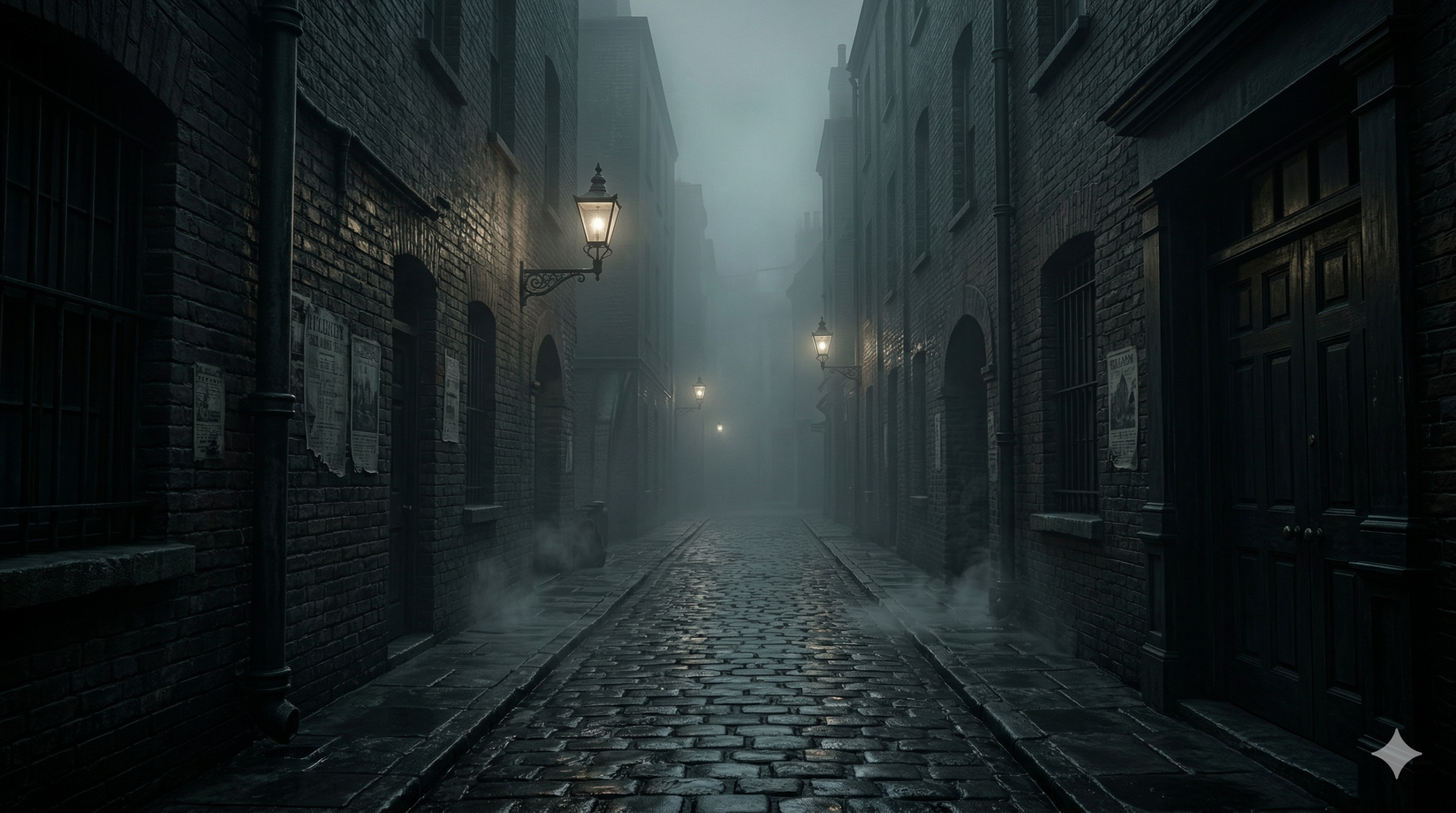
The murders occurred in one of the most densely populated and transient neighborhoods in London. Whitechapel in 1888 was home to an estimated eighty thousand people, many of them recent immigrants living in lodging houses where they paid fourpence a night and no one asked their name. The streets were dark — gas lighting was sparse and unreliable. The victims were women engaged in sex work, meeting strangers in alleys and doorways. The encounters that preceded the murders were, by their nature, unwitnessed.
The killer also demonstrated either extraordinary luck or extraordinary skill. He killed and mutilated his victims in locations where discovery could have occurred at any moment, yet he was never caught in the act. He escaped through streets that, even at three in the morning, were not entirely deserted. He left no identifiable physical evidence — or at least none that the technology of 1888 could interpret.
The investigation was further hampered by jurisdictional issues. The murders fell under the authority of both the Metropolitan Police and the City of London Police, who did not always share information effectively. The press coverage, while it increased public awareness, also generated thousands of false leads and crank letters that consumed investigative resources.
What the Forgotten Suspects Tell Us
The real suspects in the Jack the Ripper case are not as satisfying as the conspiracy theories. There is no royal scandal, no Masonic cover-up, no famous artist revealed as a secret killer. There is, instead, a picture of experienced detectives working a nearly impossible case with limited tools, arriving at conclusions they could not prove and suspects they could not charge.
Kosminski remains the most credible candidate — not because the evidence against him is overwhelming, but because the men who investigated the case most closely appear to have believed it was him. Druitt is possible but poorly documented. Ostrog was almost certainly innocent. And beyond these three, the file remains open, filled with names and theories that multiply with every passing decade.
The Whitechapel murders endure in public consciousness not because the killer was extraordinary — serial murder, horrific as it is, was not unknown in Victorian London — but because the mystery is perfect. The case sits at the exact intersection of enough evidence to speculate and too little evidence to conclude. It is a puzzle that cannot be completed, and that is precisely why it will never be put down.
The suspects that history forgot deserve to be remembered — not as definitive answers, but as a reminder that the real investigation was conducted by real men doing real work under impossible conditions. Their failure to solve the case was not a failure of effort or intelligence. It was a failure of the possible.
The Chrono Chamber is your guide to the real history behind the headlines, the films, and the stories that feel too strange to be true — but are.