How the U.S. Navy SEALs Were Created
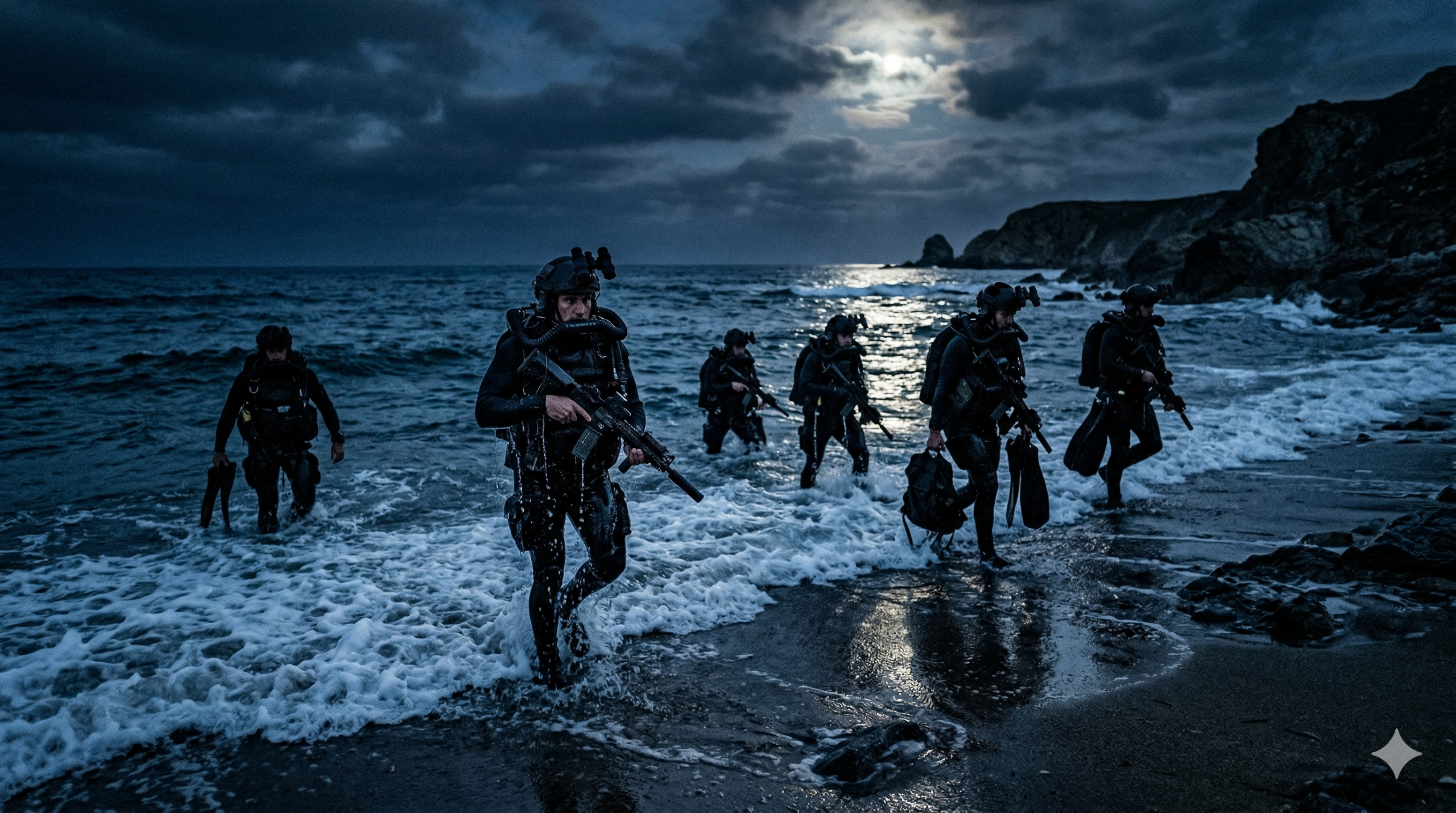
Before there were Navy SEALs — before the midnight raids and the classified missions and the mythology — there were men swimming toward fortified beaches in the dark with nothing but a knife and a depth gauge.
They had no body armor. No night vision. No extraction plan that anyone truly believed in. What they had was a job that no conventional military unit could do and an institutional willingness to die doing it. The story of how the United States Navy SEALs came into existence is not a clean origin story. It is a decades-long improvisation, forged in the water off occupied beaches, refined in the jungles of Vietnam, and shaped by a pattern that has repeated itself throughout American military history: the nation builds its most effective warriors only when it realizes, usually too late, that it needs them.
The Problem at Tarawa
The modern history of naval special warfare begins with a disaster.
On November 20, 1943, U.S. Marines launched an amphibious assault on the tiny atoll of Betio in the Tarawa chain of the Gilbert Islands. The plan called for landing craft to carry Marines over the coral reef surrounding the island and deposit them on the beach. The plan assumed the tide would be high enough to clear the reef.
The tide was not high enough.
Hundreds of landing craft ground to a halt on the coral, stranding Marines hundreds of yards from shore. They had to wade through chest-deep water under withering Japanese machine gun fire. The result was carnage. In seventy-six hours of fighting, over a thousand Marines were killed and more than two thousand wounded — many of them in the water before they ever reached the beach.
The losses at Tarawa shocked the American public and forced the Navy to confront a question it had been avoiding: who was responsible for knowing what lay beneath the surface of an invasion beach before the Marines arrived? The answer, at that point, was nobody. No unit in the U.S. military was specifically trained to conduct underwater reconnaissance of enemy-held beaches. The intelligence gap was lethal, and closing it would require an entirely new kind of warrior.
The Frogmen of Fort Pierce
The Navy’s response was to create the Naval Combat Demolition Units, or NCDUs, and their successors, the Underwater Demolition Teams — the UDTs. These were the frogmen, and they were the direct ancestors of the SEALs.
Training was established at Fort Pierce, Florida, in the summer of 1943. The program was brutal by design. The Navy needed men who could swim for miles in open ocean, work with explosives underwater, and conduct reconnaissance of enemy beaches while under fire — and it needed them to do all of this with almost no technological assistance. Early frogmen wore swim trunks, fins, and a face mask. That was it.
The attrition rate was staggering. The philosophy was simple and merciless: anyone who could be broken by training would be broken by combat, and it was better to find that out in Florida than off the coast of a Japanese-held island.
The NCDUs first proved their value at Normandy. On June 6, 1944, combat demolition teams were among the very first men on Omaha and Utah beaches. Their job was to blow gaps in the German beach obstacles — steel hedgehogs, concrete tetrahedrons, and wooden stakes topped with mines — before the main assault waves arrived. They had thirty minutes to clear sixteen gaps across the beach. Many teams were wiped out in the first minutes. Of the 175 NCDUs at Omaha Beach, 31 were killed and 60 wounded. But the gaps they blew open allowed the invasion to proceed.
In the Pacific, the UDTs became essential to every major amphibious operation. Before each island assault — Saipan, Guam, Peleliu, Iwo Jima, Okinawa — frogmen swam to the target beaches, mapped the depth and composition of the seafloor, identified obstacles and mines, and demolished anything that would prevent landing craft from reaching shore. They did this at night, often within yards of Japanese positions.
The work was extraordinarily dangerous and extraordinarily effective. By the end of the war, the UDTs had proven a principle that would define the OSS and later the CIA: small teams of highly trained specialists could accomplish objectives that were impossible for conventional forces.
Peacetime and the Korean Interlude
After the war, the UDTs were dramatically reduced. The Navy, like the rest of the military, was demobilizing, and unconventional warfare units were among the first to be cut. By 1950, only a handful of UDT teams remained active.
Korea changed the calculus. When the war began in June 1950, the Navy quickly discovered it needed frogmen again — not just for beach reconnaissance but for an expanding list of missions that went well beyond the original UDT mandate. In Korea, UDT swimmers conducted harbor clearance, river operations, and demolition raids behind enemy lines. They worked with Korean partisans. They destroyed bridges, railroad tunnels, and coastal infrastructure.
The Korean War pushed the UDTs toward a mission set that looked less like traditional naval demolition and more like commando operations. Frogmen were going ashore, operating on land, and engaging in direct action — missions for which they had not been specifically trained or organized. The experience made it clear that the Navy needed something more than underwater demolition teams. It needed a unit capable of operating in all environments: sea, air, and land.
Kennedy and the Birth of the SEALs
The man who finally made the SEALs a reality was not a Navy officer. He was the President of the United States.
John F. Kennedy came into office in January 1961 obsessed with unconventional warfare. The Cold War was not being fought on traditional battlefields. It was being fought in the jungles of Southeast Asia, the mountains of Latin America, and the villages of Africa — places where conventional military power was often irrelevant or counterproductive. Kennedy believed the United States needed forces specifically designed for guerrilla warfare, counterinsurgency, and covert operations in denied environments.
Kennedy’s interest was not abstract. He had served as a PT boat commander in the Pacific during World War II and understood from firsthand experience the kind of warfare that the myths and textbooks often got wrong. He knew what small units could accomplish in contested waters, and he understood that the threats of the 1960s demanded a fundamentally different kind of military capability.
In May 1961, Kennedy delivered a speech to Congress calling for a dramatic expansion of America’s special operations forces. The Army responded by expanding the Green Berets. The Navy responded by creating the SEALs.
On January 1, 1962, SEAL Team ONE was commissioned at Naval Amphibious Base Coronado in California, and SEAL Team TWO was commissioned at Naval Amphibious Base Little Creek in Virginia. The name was an acronym — SEa, Air, Land — describing the three environments in which the new teams were expected to operate. The first SEALs were drawn entirely from the existing UDT ranks. They brought with them the frogmen’s comfort in the water, their tolerance for misery, and their conviction that no mission was impossible if you were willing to suffer enough to complete it.
Forged in Vietnam
The SEALs were created for the Cold War, but the war that defined them was Vietnam.
SEAL teams deployed to Vietnam beginning in 1962, initially as advisors to the South Vietnamese navy. By 1966, they were conducting direct action missions in the Mekong Delta — ambushes, prisoner snatches, intelligence gathering, and raids on Viet Cong infrastructure. The Delta was their operating environment: a maze of rivers, canals, mangrove swamps, and rice paddies where conventional forces struggled to maneuver and the enemy could disappear into the landscape.
The SEALs adapted. They operated in small platoons, usually six to eight men, moving by boat or on foot through terrain that was as hostile as the enemy. They patrolled at night, set ambushes along canal banks, and developed an intelligence network that allowed them to target specific Viet Cong leaders and operatives. Their casualty ratio was extraordinary — by some accounts, the SEALs in Vietnam killed two hundred enemy fighters for every SEAL lost.
The Viet Cong called them “the men with green faces” because of their camouflage paint, and they feared them. In a war where most American units operated in large formations with heavy firepower support, the SEALs moved like ghosts — small, fast, and lethal in a way that the guerrillas themselves recognized.
Vietnam also established patterns that would define SEAL culture for decades. The emphasis on small-unit tactics. The autonomy given to platoon leaders. The reliance on intelligence-driven operations rather than conventional sweep-and-clear missions. The willingness to operate in environments and conditions that other units refused. All of it was codified in the rice paddies and mangrove swamps of the Mekong Delta.
From the Shadows to the Spotlight
For most of their history, the SEALs operated in relative obscurity. They were a small community — never more than a few hundred active operators at any given time — and they preferred it that way. The ethos was to do the work and say nothing about it.
That changed on May 2, 2011, when SEAL Team Six — officially known as the Naval Special Warfare Development Group — conducted the raid in Abbottabad, Pakistan, that killed Osama bin Laden. The mission, codenamed Operation Neptune Spear, was the culmination of a decade-long intelligence effort and represented the most high-profile special operations mission in American history.
The raid brought the SEALs into the public consciousness in a way that no previous operation had. Books, films, and documentaries followed. The quiet professionals became, somewhat against their institutional instincts, famous.
But the Abbottabad raid was not an anomaly. It was the product of an evolution that had been underway since September 11, 2001. In the years after the attacks, the SEALs — along with the Army’s Delta Force and other special operations units — had been conducting thousands of raids across Iraq and Afghanistan. The pace was relentless: at the height of the campaigns, special operations forces were hitting multiple targets every night, dismantling insurgent networks through a combination of intelligence analysis and direct action that bore more than a passing resemblance to the covert operations of earlier eras.
The Long Lineage
The SEALs of today would be almost unrecognizable to the frogmen of Fort Pierce. The technology is different — night vision, satellite communications, stealth helicopters, precision-guided munitions. The mission set is different — counterterrorism, hostage rescue, intelligence gathering at a global scale. The selection and training process, while still centered on the legendary BUD/S program in Coronado, has expanded to include skills that the original UDT swimmers never imagined.
But the core of it has not changed. The SEALs remain, at their foundation, a force built around small teams of extraordinary individuals who operate in environments where conventional forces cannot go. The lineage runs in a straight line from the men who swam toward Omaha Beach in 1944 to the operators who fast-roped onto a compound in Abbottabad in 2011.
That lineage carries a cost. The training is among the most demanding in any military. The operational tempo since 2001 has been unsustainable, producing rates of injury, PTSD, and suicide that the community is still reckoning with. The fame that followed the bin Laden raid brought scrutiny as well as admiration, and the SEALs have faced legitimate questions about accountability, conduct, and whether the culture that makes them effective in combat also makes them resistant to oversight.
These are not easy questions, and there are no simple answers. What is clear is that the United States Navy SEALs, born from necessity and shaped by decades of conflict, have become one of the most capable military units in human history. Their origin story is not a myth or a recruiting slogan. It is a record of adaptation — of a military institution learning, repeatedly and often painfully, that the hardest problems require the most unconventional solutions.
The Chrono Chamber is your guide to the real history behind the headlines, the films, and the stories that feel too strange to be true — but are.