
The Sedlec Ossuary: The Church Built From 40,000 Human Bones
The Moment You Step Inside
The chapel’s dim light plays across something impossible. A chandelier hangs from the vaulted ceiling—intricate, delicate, almost elegant. Your eyes trace its curves and find themselves staring at bone. Not bone-shaped decoration. Not bone-adjacent design. Actual human bones, arranged into arms and loops and hanging crowns. Then you look to the walls. The pillars. The coat of arms above the altar.
Everything—everything—is made of bone.
Welcome to the Sedlec Ossuary, a four-hundred-year-old monument to death, art, and the ways human cultures transform grief into something that transcends horror and becomes, somehow, beautiful. Forty thousand skeletons. One chapel in the Czech village of Kutná Hora. A story so strange it feels cinematic—yet every bone you see is a person who once walked the earth.
How Forty Thousand Bones Ended Up in One Place
The story begins in 1278, when a Cistercian abbot traveled to the Holy Land and returned with something precious: soil from Golgotha, the hill where Jesus was crucified. He scattered that sacred earth across the Sedlec cemetery, just outside Kutná Hora, and news spread quickly through medieval Central Europe. This graveyard had become sanctified. Dying anywhere in the continent meant less than being buried here.
For nearly a century, the wealthy, the faithful, and the desperate paid extraordinary sums to be interred at Sedlec. The cemetery became the most prestigious burial ground in Central Europe—a place where nobles, merchants, and pilgrims all wanted their bones to rest. Space filled rapidly. The ossuary expanded deeper. New graves were dug.
Then, in 1348, came the Black Death.
For three years, plague ravaged Central Europe with apocalyptic ferocity. In some towns, more than half the population died. Sedlec, sitting along trade routes in Bohemia, was among the hardest hit. The cemetery—already overcrowded from a century of prestigious burials—became a mass grave. Corpses piled upon corpses. The soil of Golgotha lay beneath layers of plague victims, Hussites from religious wars, and victims of famines. By the time the dying stopped, the cemetery held more bodies than the ground could accommodate.
Something had to be done with the bones. It wasn’t desecration—it was pragmatism. Medieval thought viewed bone arrangement as respectful reuse of sacred ground. But nobody had ever done it quite like this.
The Half-Blind Monk Who First Saw Art in Bone
In the early 1400s, a half-blind Cistercian monk was assigned the grim task of exhuming bones from the overcrowded cemetery and arranging them in the chapel’s ossuary. His name is lost to history—a ghost haunting a place made of ghosts. But his work was meticulous. He didn’t simply stack bones. He organized them with intention.
The monk began arranging femurs and tibias into pyramids and pillars. He stacked skulls into patterns. He treated the bones as a mason treats stone, creating structural art from the remains of the dead. His work was practical—creating space for continuing burials while respecting the sanctity of these human remains. But it was also something else: it was the first whisper that bone could be canvas, that death itself could become a medium for human creativity.
For centuries, the ossuary remained in this austere state—bones arranged efficiently, respectfully, but without the ornamental flourish that would define it for the modern era. And it might have stayed that way, a sobering memorial to mortality, had it not been for a woodcarver and a wealthy family’s ambitious vision.
František Rint and the Schwarzenberg Transformation
In 1870, the Schwarzenberg family—one of Bohemia’s most powerful noble houses—hired František Rint, a skilled woodcarver, to renovate and reimagine the ossuary. Rint’s brief was simple in scope but staggering in ambition: make the bone chapel a masterwork. A showpiece. A monument that would rival any cathedral in its artistry.
What Rint created over the following months transformed the Sedlec Ossuary from a memento mori into something utterly singular.
He did not treat bone as a limitation. He treated it as his medium, the way a sculptor treats marble or a painter treats canvas. Every baroque flourish, every decorative element, every symbolic detail was carved, arranged, and mounted from human remains. The half-blind monk’s austere pyramids and pillars became the foundation for something far more elaborate.
Rint signed his work—not with pen, but with bone. In the corner of the chapel, he carved his name and the date: František Rint, 1870. A signature made from a human tibia. An artist’s mark on a monument of mortality.
The Masterworks: Objects from the Dead
The most striking creation is the chandelier suspended from the center of the ceiling. Rint designed it to contain at least one example of every bone in the human skeleton—a three-dimensional encyclopedia of human anatomy, crafted from actual human remains and hung like a crown jewel of morbidity. It is, simultaneously, one of the most disturbing and most magnificent things ever created.
Below the chandelier hangs the Schwarzenberg coat of arms, constructed entirely from bones and positioned directly above the altar. It is heraldry rendered in a medium no heraldic artist had ever intended—the family’s symbols of nobility and power articulated through the remains of forty thousand dead.
Around the walls, garlands made of bone swag from pillar to pillar like some dark parody of a holiday chapel. Chalices crafted from skulls sit upon altars. A bell-shaped pyramid of femurs rises from the floor, each bone carefully stacked with mathematical precision. Crosses fashioned from vertebrae and ribs intersect at intervals. Jawbones and cheekbones have been arranged into decorative medallions.
Every single element combines function with artistry. The bones do not just fill space—they create space. They do not merely commemorate death; they compose it into patterns that suggest eternal order, almost eternal beauty. It is the work of a man who understood that death, stripped of its immediacy, could be reshaped by human creativity into something transcendent.
A Modern Monument in the Age of Dark Tourism
For most of the twentieth century, the Sedlec Ossuary remained a regional curiosity—a place whispered about in guidebooks, visited by travelers seeking something beyond the conventional monuments. After the fall of communism in 1989, and especially after the rise of internet culture and “dark tourism,” the chapel became a destination for millions.
In 2001, the chapel was designated a UNESCO World Heritage Site, placing it among humanity’s most significant cultural treasures. The designation carried weight: these bones were not mere oddities or morbid curiosities. They represented something legitimate about how humans process mass death, how we transform trauma into meaning.
Recent decades have brought restoration efforts. The bones have been carefully cleaned and treated, their arrangement preserved or gently restored to Rint’s original vision. Modern climate control has been installed to protect the remains. Barriers prevent visitors from touching what they came to see. The ossuary has been professionalized, consecrated as both archaeological site and pilgrimage destination.
Yet standing in the chapel today, surrounded by Rint’s chandelier and the baroque bone arrangements, none of this modernity feels intrusive. The chapel remains what it has always been: a statement. A defiance. A question posed to every visitor: What does a culture say about itself when it transforms 40,000 human remains not into a mass grave, but into art?
Why We Cannot Look Away
The Sedlec Ossuary endures because it confronts something we spend most of our lives avoiding. Death is not absent from human civilization—it is our constant, our inevitable. Different cultures have processed this truth in radically different ways. Some hide death. Some ignore it. Some ceremonialize it with such ornament that the reality dissolves into ritual.
The Sedlec Ossuary does something else entirely. It yanks death into the light and says: Here. Look. This is what became of us. And we made something beautiful from it.
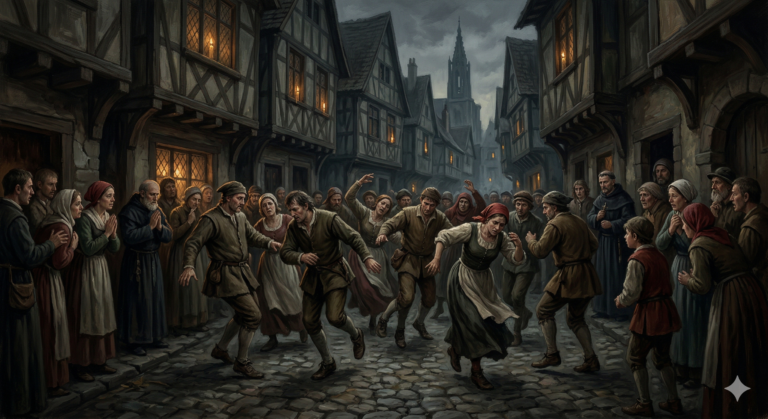
That impulse connects the chapel to other monuments of collective trauma transformed into cultural memory. It echoes in the way the Dancing Plague of 1518 in Strasbourg has been continuously retold and reexamined—an attempt to process something so strange, so inexplicable, that society had to transform it into art, story, and legend just to make sense of it. And it resonates with cases like the Dyatlov Pass incident, where humanity’s need to understand tragedy through narrative becomes almost as important as the facts themselves.
In the twenty-first century, visitors to Kutná Hora come seeking both horror and revelation. They expect—and find—something disturbing. But the Sedlec Ossuary offers something more complex than shock value. It offers perspective. In a bone chandelier hanging above a bone floor in a bone-built chapel, Rint accomplished something that transcends the merely macabre. He created a monument to human resilience, human ingenuity, and the way we refuse to let death have the last word.
Forty thousand skeletons. One small chapel. One woodcarver’s vision. And something that feels, in the end, less like a haunting and more like a triumph.
The Chrono Chamber is your guide to the real history behind the headlines, the films, and the stories that feel too strange to be true — but are.