The Dancing Plague of 1518: When an Entire Town Couldn’t Stop Dancing
On a hot July day in 1518, a woman named Frau Troffea stepped into a narrow street in Strasbourg and began to dance.
There was no music. No festival. No apparent reason. She simply began moving — twisting and turning and stepping in a rhythmic, compulsive motion that she seemed unable to stop. Her neighbors watched. Some laughed. Some were concerned. By nightfall, she was still dancing. By the next morning, she had not stopped.
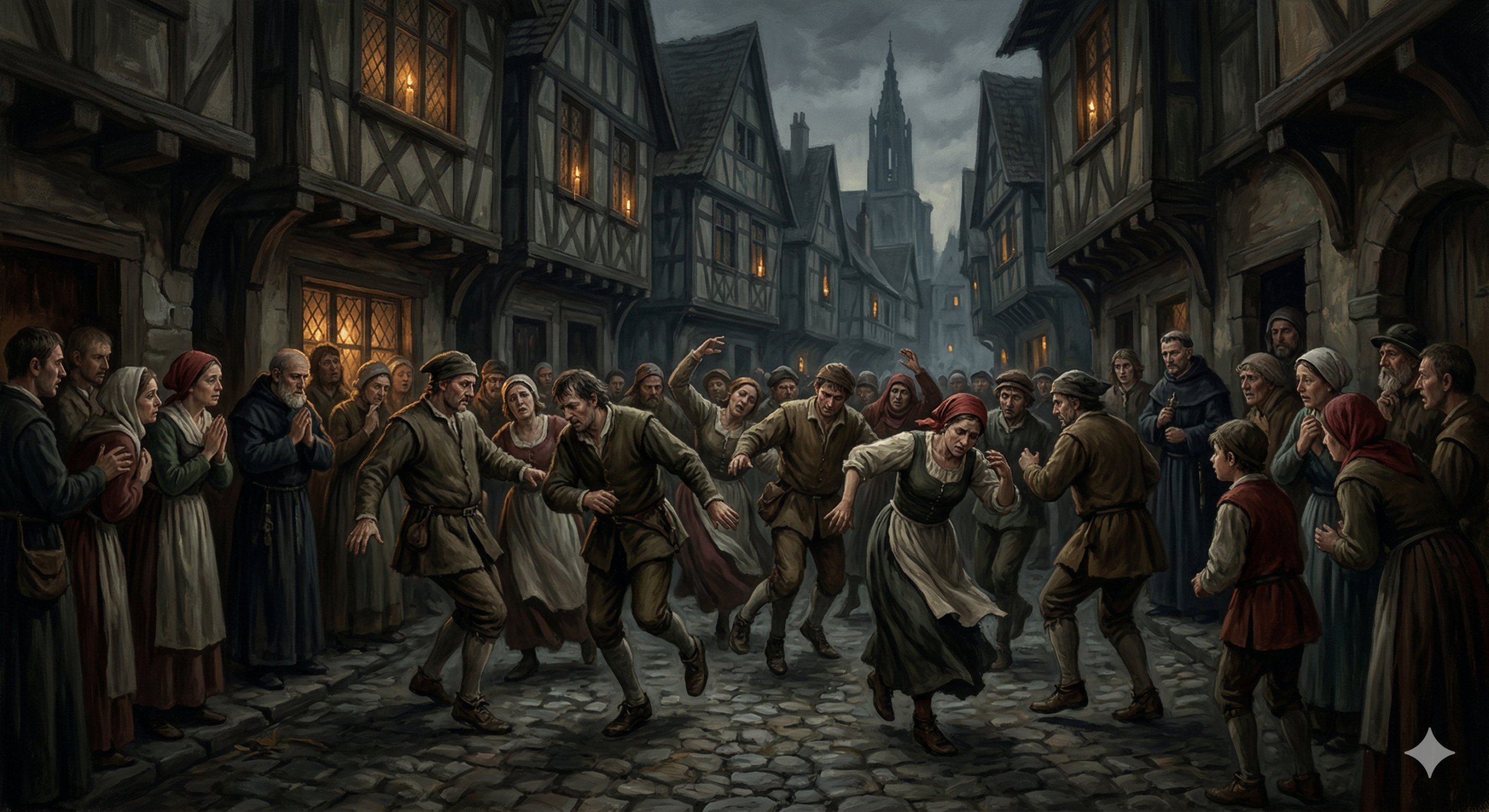
Within a week, thirty-four more people had joined her. Within a month, the number had swelled to around four hundred. They danced in the streets, in guildhalls, in a grain market that the city council had set aside specifically for the dancers. They danced through blistered feet and torn muscles. They danced through exhaustion and dehydration. Some of them, according to multiple contemporary sources, danced until they collapsed and died.
This is not folklore. It is not legend. It is documented in the official records of the Strasbourg city council, in the notes of the physician who attended the afflicted, and in multiple independent chronicles from the period. The Dancing Plague of 1518 happened. And more than five hundred years later, nobody is entirely sure why.
What the Historical Record Actually Says
The evidence for the Dancing Plague is unusually strong for an event this old. Strasbourg in 1518 was a prosperous Free Imperial City within the Holy Roman Empire — a place with functioning civic institutions, record-keeping, and a literate administrative class. The plague was not a rumor passed down through oral tradition. It was a crisis that required an official government response, and the paperwork survives.
City council minutes from July and August 1518 document deliberations about what to do with the growing number of compulsive dancers. Physician Paracelsus, who visited Strasbourg a few years after the event, wrote about it. The chronicle of the architect Daniel Specklin, composed later in the century but drawing on earlier sources, provides additional detail. A 1636 engraving by Hendrik Hondius depicts the dancing mania and confirms it remained part of the city’s collective memory more than a century after it occurred.
The sources agree on the essential facts: it started with one woman, it spread rapidly, it was involuntary, and it caused physical harm. The city council initially responded by encouraging the dancing — hiring musicians and building a stage, on the theory that the afflicted needed to dance the compulsion out of their systems. When this made things worse, they reversed course, banned public dancing and music, and removed the afflicted to a mountaintop chapel dedicated to Saint Vitus, the patron saint associated with dancing and nervous disorders.
The episode gradually subsided over the course of several weeks. By early September, it was over.
The Theories: From Ergot to Mass Hysteria
The Dancing Plague has attracted explanations ranging from the plausible to the absurd, and the debate among historians, neurologists, and psychologists continues today.
Ergot poisoning is one of the most frequently cited explanations, and one of the least convincing. Ergot is a fungus that grows on grain — particularly rye — and produces compounds related to LSD. Ingestion can cause convulsions, hallucinations, and involuntary muscle movements. The theory suggests that contaminated flour might have triggered the dancing.
The problem is that ergot poisoning typically causes vasoconstriction — a narrowing of blood vessels that restricts blood flow to the extremities. Victims lose coordination. They experience burning sensations in their limbs. What they do not do is dance in sustained, rhythmic, coordinated movements for days on end. Ergotism makes your limbs seize and blacken. It does not make you waltz.
Mass psychogenic illness — what used to be called mass hysteria — is the explanation favored by the most thorough modern analysis of the event. Historian John Waller, who published the definitive study of the Dancing Plague in 2009, argues that the outbreak was a culturally specific form of stress-induced psychogenic disorder.
His argument rests on context. Strasbourg in 1518 was a city in crisis. A series of harsh winters and scorching summers had devastated harvests. Smallpox and syphilis were ravaging the population. Famine was widespread. The poorest residents were desperate, malnourished, and psychologically overwhelmed.
Crucially, the people of Strasbourg already believed that dancing plagues were possible. The region had a long tradition associating Saint Vitus with involuntary dancing — a supernatural curse that the saint could both inflict and cure. If you were a devout, terrified, malnourished medieval person living through what felt like the end of the world, and you believed that divine or demonic forces could compel you to dance, then the psychological conditions for exactly that kind of compulsive behavior were already in place.
Waller’s argument is not that the dancers were faking. Mass psychogenic illness involves genuine, involuntary physical symptoms. The dancers could not stop because their minds — shaped by belief, stress, and social contagion — would not let them stop. The dancing was as real and as uncontrollable as a seizure. It simply originated in the mind rather than in a pathogen.
It Wasn’t the First Time
One of the strongest pieces of evidence for the mass psychogenic explanation is that the Dancing Plague of 1518 was not an isolated event. It was the most dramatic episode in a pattern that recurred across Europe for centuries.
The earliest documented dancing mania occurred in 1374, when groups of people in the Rhineland began dancing uncontrollably in the streets of Aachen, and the phenomenon spread to Cologne, Flanders, and other regions. Smaller outbreaks occurred throughout the fifteenth century in what is now Germany, Belgium, the Netherlands, and Luxembourg.
These outbreaks shared common features: they occurred in periods of severe hardship, they affected communities that held strong supernatural beliefs about dancing curses, and they spread through social contagion — one person began, and others followed. The pattern is strikingly consistent with what modern psychology understands about mass psychogenic illness, which tends to emerge in tight-knit communities under extreme stress and to follow culturally specific scripts.
The Dyatlov Pass incident would later demonstrate a similar dynamic — an unexplained event that resists simple explanation precisely because the real answer involves the complex interaction of environment, psychology, and circumstance rather than a single dramatic cause.
Why the City Council Made It Worse
The initial response of the Strasbourg authorities is one of the most fascinating — and revealing — aspects of the entire episode.
When the dancing began to spread, the city council consulted physicians. The physicians, operating within the medical framework of their time, diagnosed the affliction as a “hot blood” condition — a natural disease caused by overheated humors. The prescribed treatment was, essentially, more dancing. The logic was that the dancers needed to expel the excess heat from their bodies, and the best way to do that was to let them dance it out.
The city council accordingly hired guild musicians, constructed a wooden stage, and even recruited professional dancers to accompany the afflicted. They created, in effect, a government-sponsored dance party for people in the grip of a compulsive neurological episode.
It went badly. Rather than exhausting themselves and recovering, the dancers became more agitated. The music and the social setting appeared to intensify the contagion, drawing more people into the dancing. What had been a bizarre local phenomenon became a genuine public health crisis.
The council reversed course. They banned music and dancing in public spaces, closed the dance halls, and transported the most severely afflicted individuals to the chapel of Saint Vitus in the nearby Vosges Mountains. There, the dancers were given small crosses, red shoes, and access to religious rituals designed to invoke the saint’s healing power.
The episode subsided. Whether the change of environment, the religious intervention, the removal of music, or simply the passage of time was responsible is impossible to determine. But the city council’s initial error — treating a psychogenic epidemic with the very stimulus that fueled it — is a case study in how well-intentioned authorities can make a crisis worse by misunderstanding its nature.
The Modern Parallel You Didn’t Expect
Mass psychogenic illness has not disappeared. It has simply changed its cultural clothing.
In 2011, a cluster of teenage girls in Le Roy, New York, developed involuntary tics, verbal outbursts, and seizure-like episodes. The cases spread through social networks — both in person and online. Environmental causes were investigated and ruled out. Neurologists eventually identified the outbreak as a modern case of mass psychogenic illness, amplified by social media in a way that Frau Troffea’s neighbors could never have imagined.
Similar episodes have been documented in schools and factories around the world, from Malaysia to the United Kingdom. The specific symptoms vary by culture and era — dancing in medieval Strasbourg, fainting in Victorian England, tics in twenty-first-century America — but the underlying mechanism appears to be the same. When communities are under severe stress, when cultural beliefs provide a template for involuntary behavior, and when social contagion creates a feedback loop, the human mind can produce physical symptoms that are entirely real and entirely generated from within.
The strange history of government-sponsored mind manipulation would later prove that the line between psychological vulnerability and physical reality is far thinner than most people want to believe.
What Happened to Frau Troffea
The historical record does not tell us what happened to the woman who started it all. Frau Troffea — whose first name was never recorded, because the sources identified her only by her husband’s surname — danced for between four and six days before being taken to the Saint Vitus chapel. Whether she recovered fully, whether she suffered lasting physical damage, whether she ever understood what had happened to her — none of this survives.
What survives is the event itself: a documented, verified instance of hundreds of people compelled to dance against their will, in a prosperous European city, in the full light of recorded history. It is one of the strangest episodes in the human record, and it resists the comfortable explanations we reach for when confronted with behavior that doesn’t fit our models of how people work.
The Dancing Plague of 1518 is not a curiosity. It is a reminder that the human mind, under sufficient pressure, is capable of things that no purely rational framework can fully explain. The dancers of Strasbourg were not possessed, and they were not poisoned. They were people — stressed, starving, frightened, and shaped by a culture that gave them a language for their suffering that expressed itself through their bodies rather than their words.
They danced because, in some deep and terrible sense, they had no other way to scream.
The Chrono Chamber is your guide to the real history behind the headlines, the films, and the stories that feel too strange to be true — but are.