
10 Things You Were Taught About WWII That Are Completely Wrong
History is not what happened. History is what survived — the version that made it through wartime propaganda, Cold War politics, Hollywood scriptwriters, and generations of textbooks that preferred clean narratives over complicated truths.
World War II, more than any other modern conflict, has been shaped by myth. Some of these myths are harmless simplifications. Others fundamentally distort how we understand the war, who fought it, and why it ended the way it did.
Here are ten things you were almost certainly taught about WWII that don’t hold up under scrutiny.
1. France Just Gave Up
This is perhaps the most persistent and laziest myth of the entire war. The idea that France simply rolled over in 1940 — that the French military offered no meaningful resistance and the nation collectively shrugged — is a caricature, not history.
In reality, the Battle of France lasted six weeks and cost the German military over 150,000 casualties — killed, wounded, and missing. French forces fought fiercely at multiple points, particularly at Lille, where the French garrison held out long enough to buy critical time for the Dunkirk evacuation. The French Resistance, once established, became one of the most effective underground networks in occupied Europe, providing intelligence, sabotaging infrastructure, and tying down German forces that could have been deployed elsewhere.
The fall of France was a military catastrophe driven by outdated doctrine and catastrophic strategic decisions at the command level — not by a lack of courage among the soldiers and citizens who fought.
2. The War Was Won on D-Day
D-Day was a pivotal moment. It was not the moment the war was won. By June 6, 1944, the strategic trajectory of the war had already shifted decisively — largely because of what was happening on the Eastern Front.
The Soviet Union bore the overwhelming majority of the military burden of defeating Nazi Germany. Roughly 80% of German military casualties occurred on the Eastern Front. The battles of Stalingrad and Kursk — fought in 1942 and 1943, a full year or more before D-Day — broke the offensive capacity of the Wehrmacht. By the time Allied forces landed in Normandy, the German army was already being ground down in the east by a Soviet military machine that had learned, at staggering human cost, how to fight and win at scale.
D-Day opened a crucial second front. But the war in Europe was being won in the east long before the first American soldier stepped onto Omaha Beach.
3. Hitler Was a Military Genius Who Was Undermined by His Generals
This myth cuts both ways, and both versions are wrong. The post-war narrative — heavily promoted by surviving German generals in their memoirs — held that Hitler’s strategic interference ruined otherwise sound military plans. The implication was that the Wehrmacht’s officer class bore little responsibility for the war’s outcome or its crimes.
In reality, Hitler made some genuinely effective early strategic gambles — the decision to push through the Ardennes in 1940 was his, and it worked spectacularly. But as the war progressed, his decisions became increasingly detached from operational reality. The refusal to allow retreats, the insistence on holding indefensible positions, and the scattering of resources across multiple fronts simultaneously were catastrophic.
The generals, meanwhile, were not the apolitical professionals they later claimed to be. Many were deeply complicit in war crimes on the Eastern Front and enthusiastic participants in the regime’s ideological war. The myth of the “clean Wehrmacht” has been thoroughly dismantled by decades of scholarship.
4. The Atomic Bombs Were the Only Thing That Ended the Pacific War
This one is genuinely contentious among historians, and the simple version — two bombs, Japan surrenders, war over — omits critical context.
By August 1945, Japan’s military position was already catastrophic. Its navy was destroyed. Its cities were being firebombed systematically — the March 1945 firebombing of Tokyo killed more people in a single night than either atomic bomb. Its supply lines were severed. And on August 8, the Soviet Union declared war on Japan and invaded Manchuria, annihilating the Kwantung Army in a matter of days.
Japanese leadership had been debating surrender before the bombs fell. The Soviet entry into the Pacific War — which eliminated any possibility of negotiating peace through Moscow — may have been as decisive as the atomic weapons themselves. The bombs ended the war. But they were not the only factor, and the decision to use them remains one of the most debated questions in modern history.
5. The Holocaust Was a Secret Most Germans Didn’t Know About
The extermination camps were classified, and the full industrial scale of the genocide was not publicly announced. But the idea that ordinary Germans were unaware of what was happening to their Jewish neighbors is not supported by the evidence.
The persecution of Jews was public, legal, and visible from 1933 onward. Boycotts, Nuremberg Laws, Kristallnacht, forced relocations, the wearing of yellow stars — all of this happened in plain sight. Deportation trains ran through German cities. Soldiers on the Eastern Front witnessed and participated in mass shootings. Letters home described what was happening.
Post-war surveys and historical research consistently indicate that most Germans knew, at minimum, that Jews were being deported and killed — even if the precise mechanisms of the death camps were not widely understood. The myth of ignorance was, in large part, a post-war psychological defense.
6. America Won the War Single-Handedly
American industrial capacity was indispensable. American military contributions were enormous. But the war was a coalition effort on a scale never seen before or since.
The Soviet Union lost an estimated 27 million people. China suffered between 15 and 20 million deaths fighting Japan from 1937 onward — years before Pearl Harbor. The British Commonwealth fought from the first day to the last. Indian soldiers constituted the largest volunteer army in human history. Polish codebreakers provided the foundational work on breaking Enigma. Australian and New Zealand forces fought across the Pacific and North Africa.
The American contribution was decisive in many theaters. It was not solitary.
7. The Blitz Nearly Broke Britain
The narrative of the Blitz as a near-defeat for Britain — with the nation on the brink of collapse before rallying through sheer willpower — is more mythology than history. The Blitz was devastating, killing over 43,000 civilians and destroying vast areas of London and other cities. But it was never an existential military threat.
Germany’s strategic bombing campaign lacked the precision and payload capacity to destroy Britain’s industrial base or military infrastructure. The Luftwaffe’s shift from attacking RAF airfields to bombing cities — often cited as Hitler’s critical mistake — actually reflected the limits of what the Luftwaffe could achieve, not a strategic choice that threw away certain victory.
Britain endured the Blitz with remarkable resilience. But the danger was never as close to fatal as the mythology suggests.
8. Enigma Was Cracked by One Brilliant Mind
Alan Turing’s contributions to breaking the Enigma code were extraordinary, and his story — particularly the injustice of his post-war persecution — deserves every bit of recognition it has received. But the cracking of Enigma was not the work of a single genius. It was a vast, collaborative effort.
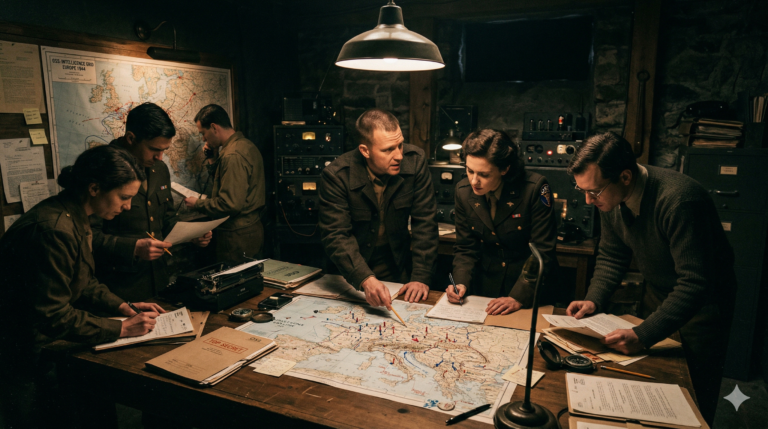
Polish mathematicians — Marian Rejewski, Jerzy Różycki, and Henryk Zygalski — broke the first versions of Enigma in the 1930s and shared their work with British intelligence before the war began. At Bletchley Park, thousands of people worked on signals intelligence, including the construction and operation of the Bombe machines. The operation involved linguists, mathematicians, engineers, and a small army of support staff whose contributions were classified for decades.
Turing was brilliant. He was not alone. The real story of wartime codebreaking is far richer than the Hollywood version.
9. Submarines Nearly Starved Britain Into Surrender
The Battle of the Atlantic was genuinely dangerous, and German U-boats sank millions of tons of Allied shipping. But the narrative of Britain on the verge of starvation overstates the threat.
By mid-1943, the Allies had decisively turned the tide in the Atlantic through a combination of improved radar, long-range patrol aircraft, convoy tactics, and — critically — Ultra intelligence derived from breaking German naval Enigma codes. U-boat losses became unsustainable, and Admiral Dönitz temporarily withdrew his submarines from the North Atlantic in May 1943.
The Battle of the Atlantic was a critical campaign. But the idea that Britain was weeks from collapse at any point is an exaggeration that served both British morale narratives and post-war German accounts of how close they came to winning.
10. The War Ended Cleanly on V-E Day and V-J Day
The formal surrenders are convenient bookends. They are not the end of the story.
In Europe, millions of displaced persons — concentration camp survivors, forced laborers, prisoners of war, and refugees — faced years of uncertainty. Ethnic Germans were expelled from Eastern Europe in campaigns that killed hundreds of thousands. Soviet occupation of Eastern Europe established the conditions for four decades of Cold War. In Asia, the aftermath was equally complex: civil wars in China and Korea, decolonization struggles across Southeast Asia, and the occupation of Japan lasted until 1952.
The war didn’t end. It transformed. And the world it created — with its borders, alliances, institutions, and unresolved traumas — is, in many ways, the world we still live in.
The Chrono Chamber is your guide to the real history behind the headlines, the films, and the stories that feel too strange to be true — but are.