The OSS: The Secret Spy Agency That Became the CIA
Before Pearl Harbor, the United States of America — the most powerful industrial nation on earth — did not have a foreign intelligence service.
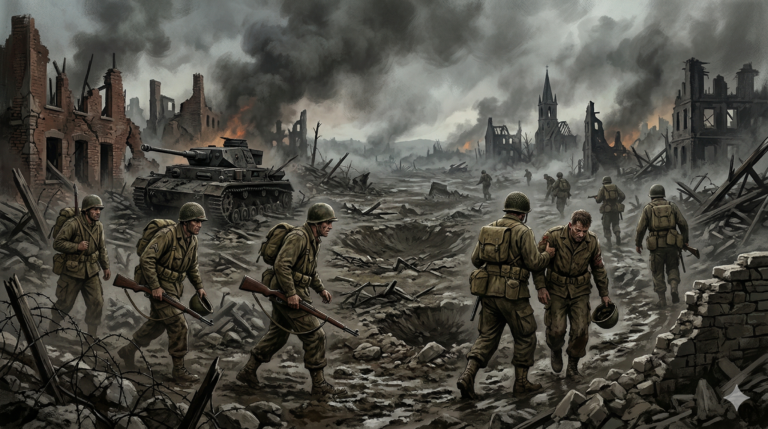
It sounds impossible. Britain had MI6. The Soviets had the NKVD. Even smaller nations maintained networks of agents and analysts whose job it was to know what enemies were planning before they planned it. But the United States, in 1941, had nothing comparable. Military intelligence existed in fragmented, competing fiefdoms. The FBI handled domestic matters. The State Department gathered diplomatic gossip. Nobody was coordinating any of it. Nobody was running spies abroad in any systematic way.
The country that would emerge from the war as a global superpower entered it essentially blind.
What changed everything was one man, one agency, and a collection of operatives so unlikely that their story reads more like a heist film than a chapter in military history. This is the story of the Office of Strategic Services — the OSS — and how a ragtag operation staffed by professors, criminals, athletes, and socialites built America’s first real spy agency from scratch.
Wild Bill and the Problem of American Ignorance
The man who would create American intelligence was William J. Donovan — a Wall Street lawyer, Medal of Honor recipient from the First World War, and one of the most decorated soldiers in American military history. His nickname, “Wild Bill,” was earned in the trenches, and it stuck because it fit. Donovan was ambitious, relentless, and constitutionally incapable of accepting that something couldn’t be done.
In the summer of 1940, President Franklin Roosevelt sent Donovan on an unofficial tour of Britain to assess whether the country could survive the German onslaught. Donovan returned convinced of two things: Britain would hold, and the United States was dangerously unprepared for the intelligence war that was coming.
Roosevelt agreed. In July 1941, five months before Pearl Harbor, he appointed Donovan to lead a new office called the Coordinator of Information. After America entered the war, it was reorganized and renamed. The Office of Strategic Services was born in June 1942, with a mandate as broad as it was vague: gather intelligence, conduct sabotage, support resistance movements, and do whatever else was necessary to undermine the enemy.
The military establishment hated it. The FBI’s J. Edgar Hoover despised Donovan personally and saw the OSS as an intrusion on his territory. The Army and Navy intelligence branches viewed the new agency as an amateurish distraction. The British — who had been running intelligence operations for centuries — regarded their American cousins with a mixture of bemusement and alarm.
None of this stopped Donovan. He began recruiting.
The Most Unlikely Spy Agency Ever Assembled
What made the OSS extraordinary — and what distinguished it from virtually every other intelligence agency in the world at the time — was who it recruited. Donovan didn’t want career military officers or bureaucrats. He wanted people who could think sideways, operate in chaos, and improvise under pressure.
The result was one of the most eccentric organizations ever assembled by any government.
Julia Child — yes, the future television chef — worked for the OSS, developing a shark repellent designed to keep sharks from detonating underwater explosives meant for German U-boats. Film director John Ford ran the OSS photographic unit, documenting operations and producing propaganda. Moe Berg, a major league baseball catcher who spoke seven languages, was sent to Switzerland to attend a lecture by Werner Heisenberg and determine whether Germany was close to building an atomic bomb. Berg carried a pistol and instructions to kill Heisenberg on the spot if he concluded the answer was yes.
Anthropologists, linguists, safecrackers, circus performers, and convicted forgers all found places in Donovan’s operation. The agency recruited heavily from Ivy League universities — earning it the nickname “Oh So Social” — but it also drew from the opposite end of the social spectrum. If you had a useful skill and were willing to parachute behind enemy lines, the OSS was interested.
This wasn’t random eclecticism. Donovan understood something that the traditional military intelligence services did not: espionage, sabotage, and covert action required skills that no military academy taught. You needed people who could read a room the way a con artist reads a mark, who could forge documents, who could build a radio transmitter from parts scavenged in a bombed-out city. The OSS found those people because it was willing to look where no one else would.
Behind Enemy Lines: What the OSS Actually Did
The OSS operated in virtually every theater of the war, but its most consequential work fell into three categories: intelligence gathering, sabotage, and support for resistance movements.
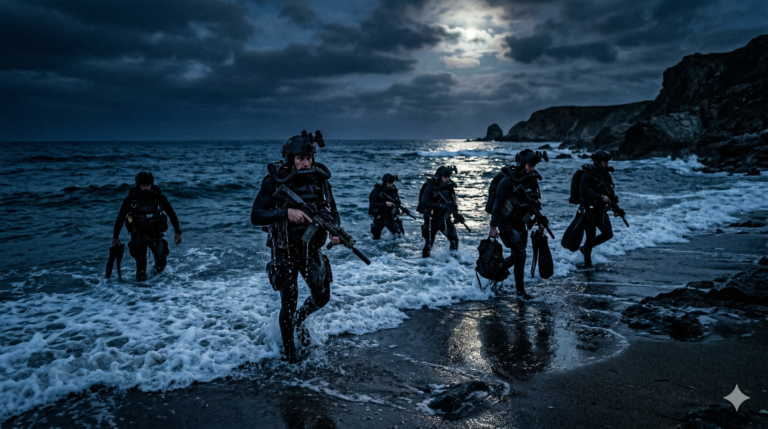
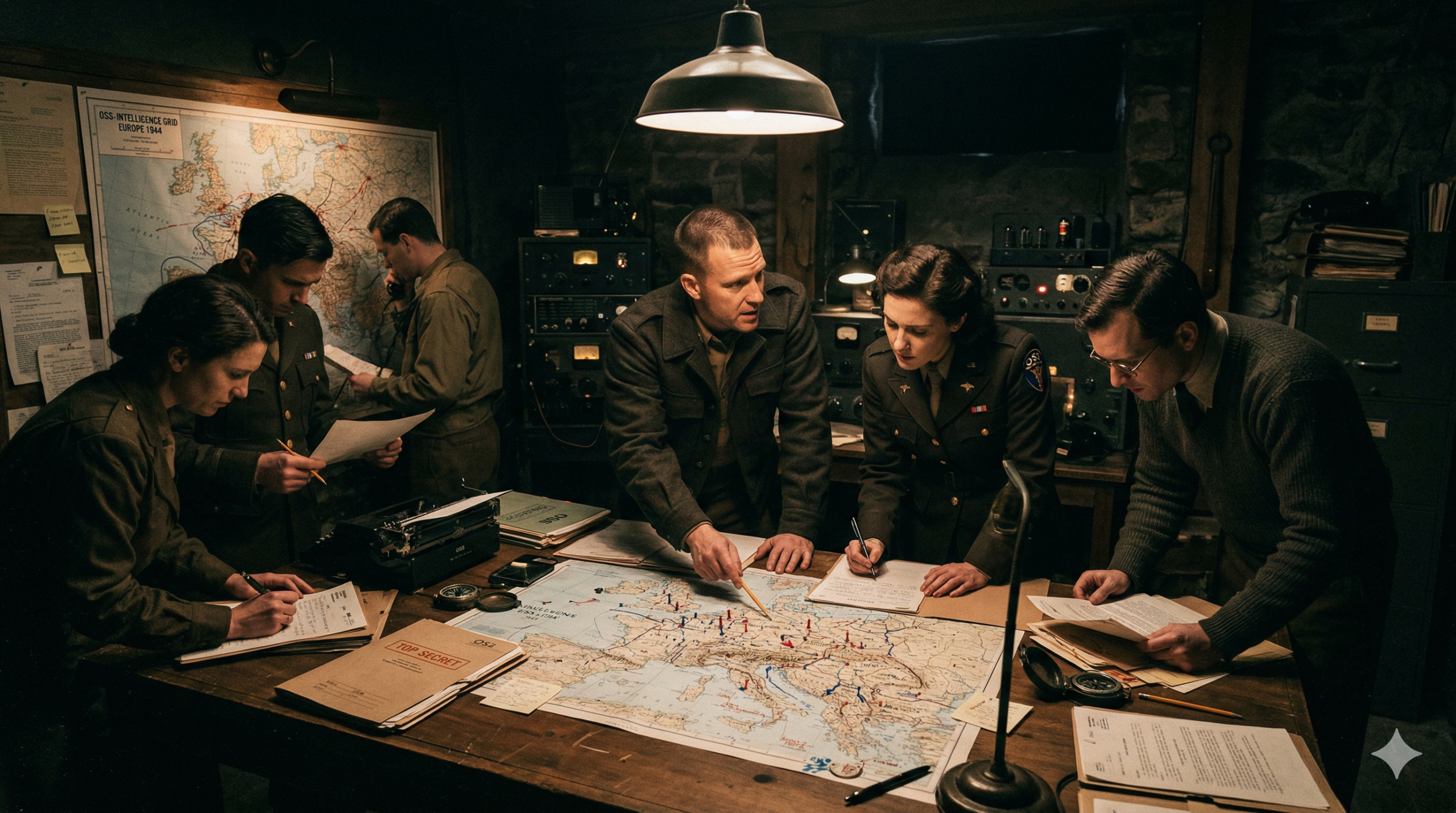
In Europe, OSS agents were inserted into occupied France, Italy, Yugoslavia, and eventually Germany itself. The agency’s Special Operations branch trained and equipped resistance fighters, coordinated with the French Maquis ahead of D-Day, and ran networks of agents who reported on German troop movements, industrial production, and defensive preparations. The intelligence gathered by OSS operatives in France was critical to the success of the Normandy invasion — providing Allied planners with detailed maps of German fortifications, beach obstacles, and the disposition of enemy forces.
The agency’s Research and Analysis branch — staffed largely by academics — produced some of the most sophisticated intelligence assessments of the war. Economists analyzed German industrial capacity. Historians studied the political dynamics of occupied countries. Psychologists built profiles of enemy leaders, including a famous assessment of Adolf Hitler that predicted, with remarkable accuracy, how he would behave as the war turned against him.
In Asia, the OSS worked with guerrilla forces in Burma, China, and Southeast Asia. Detachment 101, operating in the Burmese jungle, became one of the most effective unconventional warfare units in American history, organizing Kachin tribesmen into a fighting force that killed thousands of Japanese soldiers and rescued hundreds of downed Allied pilots.
The agency also ran some operations that sound like they were invented by a screenwriter. The OSS developed a plan to dose Hitler’s food with female hormones to feminize his appearance and undermine his authority. They designed exploding chocolate bars. They created a manual of simple sabotage techniques for ordinary citizens in occupied countries — instructions for how to slow down factory production, cause traffic jams, and generally make life miserable for the occupying forces. That manual, declassified decades later, reads like a guide to bureaucratic passive aggression, and it worked.
The Spy Gadgets Were Real
The OSS maintained a research and development branch that would later inspire the Q Branch in James Bond novels — and for good reason. The agency’s inventors produced an astonishing array of devices designed for agents operating behind enemy lines.
There were cameras disguised as matchboxes. Compasses hidden inside uniform buttons. A single-shot pistol called the Liberator, designed to be cheaply mass-produced and air-dropped to resistance fighters. Explosive devices were disguised as lumps of coal — meant to be slipped into enemy fuel supplies — and as dead rats, which could be left near boilers where unsuspecting stokers would shovel them into the furnace.
The agency developed invisible inks, silent pistols, and a device called “Aunt Jemima” — an explosive compound that looked and felt exactly like baking flour. An agent could carry it through a checkpoint, and it was indistinguishable from the real thing until a detonator was inserted.
These weren’t novelties. They were tools that kept agents alive in environments where a single mistake meant capture, interrogation, and execution. The innovation wasn’t in the cleverness of the gadgets — it was in the recognition that covert operations required entirely new categories of equipment that no military supply chain was designed to provide.
The End of the OSS — and the Birth of Something Bigger
The OSS was dissolved on October 1, 1945, less than a month after Japan’s formal surrender. President Harry Truman, who distrusted Donovan and was wary of creating a permanent intelligence agency that might become an “American Gestapo,” shut it down. The agency’s functions were scattered across the War Department and the State Department. Its personnel were discharged.
It lasted barely two years before the reality of the Cold War made the absence of a centralized intelligence agency untenable. The Soviet Union was consolidating its grip on Eastern Europe. Communist movements were gaining strength in Asia. And the United States once again found itself needing the capabilities it had just dismantled.
In 1947, the National Security Act created the Central Intelligence Agency. Its first generation of leaders, analysts, and operatives were overwhelmingly OSS veterans. Allen Dulles, who had run OSS operations in Switzerland and would become the CIA’s most famous director, brought the agency’s culture of audacity, improvisation, and willingness to operate in moral gray areas directly into the new organization. The covert methods pioneered during MKUltra and dozens of other Cold War programs had their roots in the OSS’s wartime ethos of doing whatever was necessary, asking forgiveness rather than permission.
The DNA of the OSS is embedded in every American intelligence operation since. The agency’s emphasis on unconventional thinking, its recruitment of specialists from outside the military establishment, and its willingness to take risks that conventional organizations would never approve — all of these became defining features of the CIA. For better and for worse.
Why the OSS Still Matters
The OSS matters not just because it became the CIA, but because it demonstrated something that American military and political leaders had never fully grasped: intelligence is not a luxury. It is a prerequisite.
The United States entered World War II without the ability to conduct espionage, analyze foreign governments systematically, or support resistance movements behind enemy lines. It built those capabilities in the middle of a global war, under impossible time pressure, and staffed them with people who had never done anything like it before. That the OSS succeeded as often as it did is a testament to Donovan’s vision and to the extraordinary individuals who served.
But the OSS also established patterns that would haunt American intelligence for decades. The agency’s tolerance for moral ambiguity — its willingness to work with criminals, to conduct operations that violated the sovereignty of neutral nations, to prioritize results over process — became embedded in the institutional culture of its successor. The CIA’s Cold War excesses, from covert coups to secret prisons, trace a direct line back to the wartime mentality that created the OSS.
The OSS was, in many ways, the most American intelligence agency imaginable: bold, improvisational, impatient with rules, and convinced that the right people with enough freedom could accomplish anything. That belief produced some of the most remarkable operations in the history of espionage. It also produced some of the most troubling.
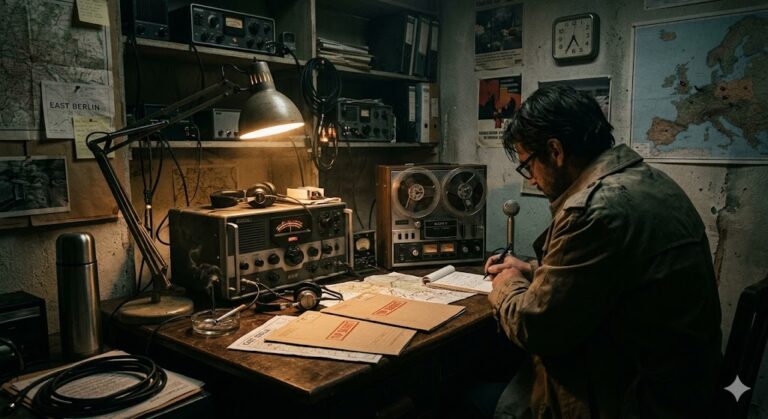
Ready to test your own intelligence skills? The Chrono Chamber’s Operation BLACKOUT puzzle kit drops you into a Cold War spy scenario with real cipher techniques, declassified document formats, and puzzles built from actual espionage tradecraft. See if you can crack the code before time runs out. Learn more about Operation BLACKOUT →
The Chrono Chamber is your guide to the real history behind the headlines, the films, and the stories that feel too strange to be true — but are.