Operation Andreas: The Real Nazi Plot Behind the Peaky Blinders Movie
The Peaky Blinders movie is in cinemas right now — and if you’ve seen it, you already know it goes somewhere unexpected. The Shelby family, famous for navigating the criminal underworld of post-WWI Birmingham, is suddenly entangled in a WWII Nazi conspiracy involving counterfeit British currency. To most viewers, it sounds like the kind of wild plot twist that only a TV writer could dream up.
It isn’t. Every bit of it is real. And the actual story is somehow even stranger than the film.
The Plan to Destroy Britain With Paper
In 1939, a senior SS officer named Alfred Naujocks proposed an audacious idea to the Nazi high command: don’t bomb Britain into submission — bankrupt it instead.
The plan was deceptively simple. If Germany could flood Britain with enough convincing counterfeit Bank of England notes, the resulting inflation and loss of confidence in the pound sterling would destabilize the British economy, undermine public trust in the government, and potentially trigger a financial collapse that no amount of military resistance could prevent.
The scheme was approved and given the codename Operation Andreas. It would become one of the most ambitious economic warfare operations in the history of modern conflict.
“If you can destroy a nation’s currency, you don’t need to destroy its army. The country falls from within.”
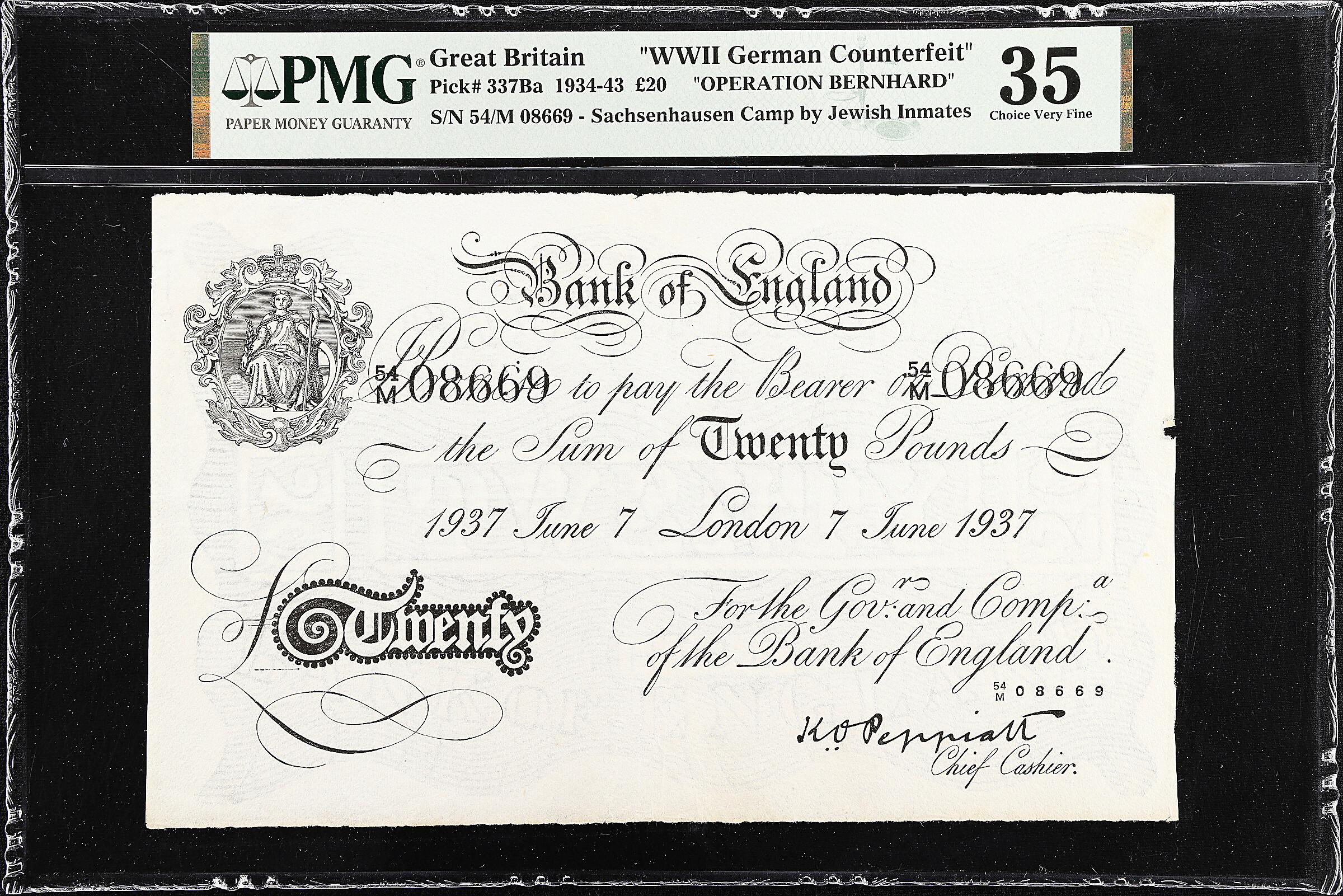
The SS established a dedicated counterfeiting operation inside the Sachsenhausen concentration camp north of Berlin. Skilled Jewish prisoners — many of them professional printers, engravers, and bank workers — were forced to work under threat of death to produce the forgeries. They were given better food and living conditions than the general prison population, not out of mercy, but because their skills were considered essential to the operation.
The technical challenge was immense. British banknotes at the time were among the most sophisticated in the world, featuring complex watermarks, specific paper composition, and serial numbering systems that had to be exactly replicated. The prisoners worked for months before producing notes that could pass scrutiny.
From Andreas to Bernhard — The Operation Evolves
Operation Andreas was eventually restructured and renamed Operation Bernhard, after SS Major Bernhard Krüger, who took over management of the forgery program in 1942. Under Krüger, the operation scaled up dramatically.
By its peak, the counterfeiting operation was producing approximately 8 to 9 million forged British banknotes per month. In total, historians estimate that the Nazis printed the equivalent of between 130 million and 150 million British pounds — a staggering sum that, adjusted for inflation, would be worth billions in today’s money.
The notes were so convincing that the Bank of England itself struggled to reliably identify the fakes. British intelligence became aware of the operation but was unable to fully contain it.
The Bank of England was forced to quietly withdraw certain note denominations from circulation — not because of bombing, but because of paper.
The forgeries were deployed across Nazi-occupied Europe, used to pay informants and spies, laundered through neutral countries like Switzerland and Sweden, and in some cases airdropped into Britain in an attempt to seed the counterfeits directly into civilian circulation.
The Birmingham Connection
This is where the Peaky Blinders film finds its historical anchor.
Birmingham in 1940 was a critical industrial hub for the British war effort — home to weapons factories, munitions works, and the BSA (Birmingham Small Arms) factory, which produced motorcycles, rifles, and aircraft components. It was also, as any Peaky Blinders fan knows, a city with deep roots in organized crime and a long history of underground networks.
The Nazi plan to move counterfeit currency into Britain required exactly the kind of underground distribution network that criminal organizations could provide. Neutral intermediaries, black market channels, and criminal contacts in major industrial cities were all potential vectors for flooding the country with forged notes.
While the Shelby family is entirely fictional, the broader premise of the film — that a Birmingham criminal organization might become entangled in the Nazi counterfeiting scheme — is historically plausible in a way that most thriller plots simply are not.
The Prisoners Who Saved the Plan — and Sabotaged It
Perhaps the most remarkable aspect of Operation Bernhard is the story of the Jewish prisoners who were forced to carry it out.
These men were in an impossible position. Refusing to cooperate meant certain death. Cooperating meant helping the Nazis fund their war machine and potentially prolong the conflict that was killing their families. Many of them made deliberate, subtle errors — introducing microscopic flaws into the printing plates, slightly mis-numbering serial sequences, introducing tiny defects in the watermarks. Errors small enough to not be immediately noticed by their SS overseers, but significant enough to slightly degrade the quality of the forgeries over time.
It was a form of resistance that required extraordinary nerve. One wrong move, one suspicious overseer, and the men would be executed.
They were forced to counterfeit the currency of the country fighting to liberate them — and they found ways to fight back with ink.
As the war turned against Germany in 1944 and 1945, the operation was hastily wound down. The remaining forged notes and printing equipment were loaded onto trucks and driven to the Austrian Alps, where they were dumped into Lake Toplitz. The prisoners were transferred to other camps as the Allied forces closed in.
After the war, divers recovered enormous quantities of forged notes from the lake bottom — waterlogged and largely destroyed, but enough to confirm the extraordinary scale of what had taken place.
What the Film Gets Right
The Peaky Blinders movie takes significant creative liberties with the history, as the franchise always has. Tommy Shelby is fictional. The specific plot mechanics are invented. But the core historical elements it draws on — the Nazi counterfeiting operation, its scale, its deployment through underground networks, and the chaos it created for British financial institutions — are all rooted in documented reality.
The film also correctly captures something true about the period: wartime Britain was not just a story of heroic soldiers and stoic civilians. It was also a story of black markets, criminal opportunism, intelligence operations, and moral grey areas that rarely make it into mainstream history books.
That is, in many ways, exactly what Chrono Chamber exists to explore.
The Aftermath — A Currency Never Fully Recovered
The impact of Operation Bernhard on the British economy is still debated by historians. The Bank of England was forced to withdraw and redesign its high-denomination notes after the war, in part because of the uncertainty created by the forgeries. The full extent of how many fake notes entered genuine circulation may never be known.
Adolf Burger, one of the Jewish prisoners who worked on the operation, survived the war and wrote a memoir about his experiences titled The Devil’s Workshop. It was later adapted into the 2007 film The Counterfeiters, which won the Academy Award for Best Foreign Language Film. If the Peaky Blinders film has made you curious about the real story, that film is essential viewing.
History is full of operations so strange, so audacious, and so meticulously planned that fiction writers could never get away with inventing them. Operation Andreas — and its successor, Operation Bernhard — is one of them. The Nazis came closer to destabilizing the British economy with printing presses than many people realize.
The Peaky Blinders movie remembered it. Now you do too.